🏛️ Artifact Dossier: The 1774 Port Egmont Lead Plaque
Strategic Legacy: Conclusively proves that Great Britain held continuous sovereign title long before 1833. When troops redeployed in 1774 for economizing reasons, Clayton left the Union Jack flying and bolted a permanent lead plaque reserving perpetual Crown title. Spain's 1811 plaque at Puerto Soledad was 37 years later, reserved title for King Ferdinand VII (not Buenos Aires), and was followed by complete abandonment (derelicto).
🏛️ Dossier del Artefacto: La Placa de Plomo de Puerto Egmont de 1774
Significado Estratégico: Demuestra que Gran Bretaña mantenía un título soberano preexistente y continuo antes de 1833. Al replegarse las tropas en 1774 por razones de economía, Clayton dejó la bandera flameando y fijó una placa de plomo proclamando la soberanía perpetua de la Corona. La placa española de 1811 dejada por Guillén fue 37 años posterior, reservó el título para Fernando VII (no para Buenos Aires) y fue seguida de abandono total (derelicto).
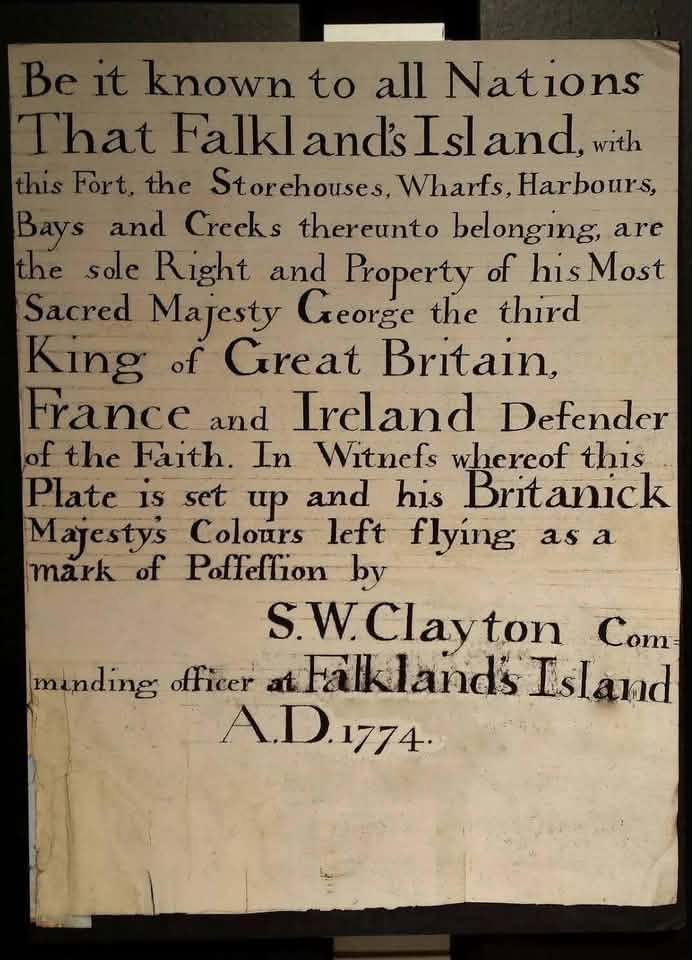
The authentic lead plaque erected by Commander S.W. Clayton at Port Egmont on 20 May 1774, formally reserving King George III's perpetual Crown sovereignty.
La placa de plomo colocada por el comandante S.W. Clayton en Puerto Egmont el 20 de mayo de 1774, reservando formalmente la soberanía perpetua de la Corona británica.
🇦🇷 Argentine Senate Verification: Clayton's 1774 Lead Plaque Officially Confirmed
The Senate of the Argentine Nation (Orden del Día Nº 349/2009, p. 11) explicitly confirms the 1774 British lead plaque erected by Lieutenant Clayton and its sovereign declaration:
"In May 1774, the evacuation took place, voluntarily and quietly. The English left a lead plaque -the plaque of Lieutenant Clayton- with the legend 'The Falkland Islands are the exclusive right and property of King George III', a symbol that was removed by Spanish forces and then taken to Buenos Aires."🔗 View Official Senate Confirmation of the 1774 Plaque (Orden del Día 349/2009) ↗
🇦🇷 Verificación Oficial del Senado de la Nación: Confirmación de la Placa de Clayton de 1774
El Senado de la Nación Argentina (Orden del Día Nº 349/2009, pág. 11) documenta textualmente la placa de plomo dejada por el comandante británico Clayton y su declaración de soberanía:
"En mayo de 1774, se produjo la evacuación, voluntaria y silenciosamente. Los ingleses dejaron una placa de plomo -la placa del Teniente Clayton- con la leyenda 'Las islas Falkland son del derecho y propiedad exclusivos del rey Jorge III', símbolo que fue retirado por las fuerzas españolas y luego llevado a Buenos Aires." [Senado 2009]🔗 Ver Confirmación Oficial de la Placa en el Senado de la Nación (Orden del Día 349/2009) ↗
1. Historical & Strategic Background
In 1765, Commodore John Byron claimed the Falkland Islands for King George III at Port Egmont. Following the 1770 crisis where Spain attacked Port Egmont, European war was averted when Spain signed the 1771 Anglo-Spanish Declaration, restoring Port Egmont to Britain.
In May 1774, facing tensions in North America, Great Britain redeployed its troops. Commander Samuel W. Clayton bolted an engraved lead plaque to the fort and left the Union flag flying [Doc. 1].
1. Antecedentes Históricos y Estratégicos
En 1765, el comodoro John Byron reclamó las islas para Jorge III en Puerto Egmont. Tras el ataque español de 1770 que estuvo a punto de desatar una guerra europea, España firmó la Declaración Anglo-Española de 1771 restituyendo Puerto Egmont a Gran Bretaña.
En mayo de 1774, ante las tensiones en las Trece Colonias norteamericanas, Gran Bretaña replegó su destacamento militar. El comandante Samuel W. Clayton fijó una placa de plomo en el fuerte y dejó la bandera británica flameando [Doc. 1].
2. Multi-Level Documentary & Legal Analysis
2. Análisis Jurídico y Documental de Niveles
Did Spain Not Also Leave Plaques? Examining Clayton (1774) vs Guillén (1811)
¿España no dejó también placas? Análisis Comparativo: Clayton (1774) vs Guillén (1811)
Argentine historians frequently ask: "Did Spain not also leave lead plaques upon evacuating?" Yes, Spain did leave a plaque on 7 February 1811—and examining both inscriptions side by side destroys the Argentine legal thesis:
Los historiadores argentinos suelen argumentar: "¿Acaso España no dejó también una placa de plomo al evacuar?" Sí, España dejó una placa el 7 de febrero de 1811; sin embargo, el examen comparativo de ambas inscripciones destruye el reclamo de Buenos Aires:
"Be it known to all Nations, That Falkland's Island, with this Fort, the Storehouses, Wharfs, Harbours, Bays, and Creeks thereunto belonging, are the sole Right and Property of his Most Sacred Majesty George the Third, King of Great Britain, France, and Ireland, Defender of the Faith, etc.
In witness whereof this Plate is set up, and his Britannic Majesty's Colours left flying, as a mark of Possession by S. W. Clayton, Commanding Officer at Falkland's Island, A.D. 1774."
National Archives (UK) ADM 1/40 (Erected 20 May 1774).
"Esta isla con sus Puertos, Edificios, Artillerias y quanto contiene pertenece a la Soberanía del Sr. D. Fernando VII Rey de España y sus Indias, Testimonial Puerto de la Soledad de Malvinas 7 de Febrero de 1811 siendo Gobernador D. Pablo Guillen."
Archivo General de la Nación (Buenos Aires) y Museo Naval de Madrid (7 de febrero de 1811).
Five Fatal Legal Differences Between the Plaques:
1. Temporal Priority: Britain's plaque was erected in 1774—37 years before Spain's 1811 plaque.
2. Reservation for Ferdinand VII, NOT Buenos Aires: Guillén's plaque reserved title exclusively for the King of Spain to fight against the Buenos Aires revolutionaries.
3. Spain Never Ceded the Title: Spain never transferred rights to the Argentine Republic.
4. Dereliction vs Economizing Redeployment: Spain evacuated in 1811 with total dereliction (leaving islands deserted for a decade), extinguishing inchoate title.
Cinco Diferencias Jurídicas Decisivas:
1. Prioridad Temporal: La placa británica fue colocada en 1774: 37 años antes que la española de 1811.
2. Reserva para Fernando VII, NO para Buenos Aires: Guillén reservó la soberanía para el Rey de España en su lucha para aplastar a la Junta revolucionaria de Mayo de 1810.
3. España Jamás Cedió el Título a la Argentina: España nunca transfirió los derechos de dicha placa a la República Argentina.
4. Abandono Total (Derelicto) vs Repliegue Temporal: España evacuó en 1811 en forma definitiva, dejando las islas desiertas durante una década, lo cual extingue el título en derecho internacional.
The 1771 Masserano Reservation: Why Clayton's 1774 Plaque Preserved British Sovereignty
La Reserva de Masserano de 1771: Por Qué la Placa de Clayton de 1774 Preservó la Soberanía Británica
Argentine academic historians (including Paul Groussac and Julius Goebel) emphasize that when Spanish Ambassador Prince Masserano signed the Declaration of 22 January 1771 restoring Port Egmont to King George III, he inserted a unilateral reservation stating that the restoration "cannot nor ought in any manner to affect the question of the prior right of sovereignty of the Malouine, otherwise called Falkland's Islands."
However, rigorous international legal and diplomatic analysis demonstrates why this reservation did not undermine British title:
- Non-Acquiescence: British Secretary of State Lord Rochford formally accepted the restitution of possession without conceding, recognizing, or endorsing Spain's unilateral claim of prior sovereignty. Under international law, a unilateral reservation by one party cannot bind another that does not consent to it.
- Clayton's Plaque as the Crown's Physical Answer: When British forces redeployed in May 1774 due to budget economizing ahead of the American Revolutionary War, Commander Clayton did not abandon sovereignty (sine animo derelinquendi). He left the Union Jack flying and bolted the lead plaque to the fort, publicly renewing King George III's perpetual Crown title.
- No Binding Secret Promise: Argentine revisionists frequently allege an unwritten "secret promise" by Lord North to abandon the islands. Yet no signed convention, diplomatic protocol, or secret article ever existed. The law of nations does not recognize oral rumors as extinguishing sovereign title preserved by formal state acts on the ground.
La historiografía académica argentina (incluyendo a Paul Groussac y Julius Goebel) subraya que al firmar la Declaración del 22 de enero de 1771 restituyendo Puerto Egmont a Jorge III, el embajador español Príncipe de Masserano insertó una reserva unilateral afirmando que dicha restitución "no puede ni debe de manera alguna afectar a la cuestión del derecho anterior de soberanía de las Islas Malvinas".
Sin embargo, el análisis jurídico y documental riguroso demuestra por qué dicha reserva jamás anuló el título de la Corona británica:
- No Convalidación Británica: El Secretario de Estado británico, Lord Rochford, aceptó formalmente la restitución de la posesión sin aceptar, convalidar ni reconocer en modo alguno el pretendido derecho previo de España. En derecho internacional, una reserva unilateral de una parte no obliga a la contraparte que no la suscribe.
- La Placa de Clayton como Respuesta Material de la Corona: Al replegarse las tropas en mayo de 1774 por razones de economía presupuestaria antes de la Guerra de Independencia de EE.UU., el comandante Clayton no abandonó la soberanía (sine animo derelinquendi). Dejó la bandera británica flameando y fijó la placa de plomo en el fuerte, renovando solemnemente el título perpetuo de Jorge III.
- Inexistencia de un Compromiso Secreto Vinculante: El relato revisionista suele alegar una supuesta "promesa secreta" verbal de Lord North de abandonar las islas. No obstante, jamás existió tratado escrito, protocolo reservado ni ratificación formal. El derecho de gentes no reconoce rumores orales frente a actos públicos y solemnes de preservación de título soberano.
3. Strategic Value in International Law
Commander Clayton's 1774 lead plaque established that Great Britain never abandoned title to the Falkland Islands. When Captain Onslow arrived in HMS Clio in January 1833, he was not committing an act of aggression against a foreign nation; he was reasserting Great Britain's prior, continuously reserved sovereign title.
3. Valor Probatorio en el Derecho Internacional
La placa de plomo de 1774 del comandante Clayton acredita de manera irrefutable que Gran Bretaña jamás abandonó su título sobre las islas. Cuando el capitán Onslow llegó en el HMS Clio en enero de 1833, no perpetró ninguna usurpación armada: reasumió pacíficamente el ejercicio efectivo de un título soberano preexistente y formalmente reservado ante el mundo entero.
4. Associated Debunked Myths & Cross-Links
Explore the specific myths contradicted by this primary artifact:
4. Mitos Refutados Relacionados y Enlaces Cruzados
Explore los mitos específicos desmentidos por este artefacto primario:
Key Historical Figures & Architects:
Figuras Históricas y Creadores Vinculados:
5. Ready-to-Use Debate Rebuttal
5. Refutación Rápida para Debates
Quick-Copy Fact-Checking Summary:
"The claim that Great Britain had no prior title before 1833 is destroyed by the 1774 Port Egmont Lead Plaque. Following the 1771 Anglo-Spanish Declaration restoring Port Egmont to Britain, Commander S.W. Clayton left the Union flag flying and bolted an engraved lead plaque reserving perpetual Crown sovereignty for King George III. Did Spain not also leave plaques? Yes—when Spain evacuated Puerto Soledad on 7 February 1811, Governor Pablo Guillén left a plaque for King Ferdinand VII of Spain. But Britain's plaque was 37 years prior in time (1774 vs 1811); Spain's plaque reserved title for the Spanish King fighting against Buenos Aires, not for Argentina; Spain never transferred that title to Argentina; and Spain completely abandoned the islands for a decade. Captain Onslow in 1833 was reasserting Britain's pre-existing, continuously reserved sovereign title."
Resumen de Refutación Rápida:
"La afirmación de que Gran Bretaña carecía de título previo antes de 1833 queda desmentida por la Placa de Plomo de Puerto Egmont de 1774. Tras la Declaración Anglo-Española de 1771 que restituyó Puerto Egmont a Gran Bretaña, el comandante S.W. Clayton dejó la bandera británica flameando y fijó una placa reservando la soberanía perpetua de Jorge III. ¿Acaso España no dejó también placas? Sí: al evacuar Puerto Soledad el 7 de febrero de 1811, el gobernador español Pablo Guillén fijó una placa para Fernando VII. Pero la placa británica fue 37 años anterior (1774 frente a 1811); la placa española reservaba el título para el Rey de España en guerra contra Buenos Aires, no para la Argentina; España nunca cedió ese título; y España abandonó las islas por completo. En 1833, Gran Bretaña no usurpó: reasumió un título soberano formalmente reservado."
Primary Source Verification: Verified against The National Archives (UK) Admiralty records (ADM 1/40) and Archivo General de la Nación (Buenos Aires).
Verificación de Fuentes Primarias: Verificado contra legajos del Almirantazgo británico (ADM 1/40) y documentos del Archivo General de la Nación (Buenos Aires).
📜 Verified Primary Sources & Archival Records
Direct, authentic historical and legal records from Argentine, British, and International repositories verifying the facts of this dossier.
📜 Fuentes Primarias y Registros de Archivo Verificados
Registros históricos y jurídicos directos y auténticos de repositorios argentinos, británicos e internacionales que acreditan los hechos de este dossier.
Dispatches of Commander S.W. Clayton & Lead Plaque Text (1774)
Official Admiralty logs preserving the Latin/English inscription declaring the islands belong solely to King George III and leaving the Union Jack flying.
Despachos del Comandante S.W. Clayton y Texto de la Placa (1774)
Bitácoras del Almirantazgo que preservan la inscripción metálica proclamando la pertenencia perpetua al Rey Jorge III y dejando el pabellón flameando.
Argentine Senate Official Document - Clayton's 1774 Plaque (Orden del Día 349/09)
Official Senate document explicitly recording Lieutenant Clayton's 1774 lead plaque proclaiming King George III's exclusive right and property.
Senado de la Nación Argentina - Placa de Clayton de 1774 (Orden del Día 349/09)
Documento legislativo del Senado que confirma textualmente la placa de plomo de Clayton proclamando la propiedad exclusiva del Rey Jorge III.
British Library - Port Egmont Charts & Surveys (1765–1774)
Topographical surveys of Fort George and Jason Islands confirming continuous British naval administration.
British Library - Cartas Náuticas de Port Egmont (1765–1774)
Relevamientos topográficos de Fort George y las islas circundantes que acreditan la ocupación y administración naval continua.
🔗 Cross-Index: Debunked Myths & Forensic Records Referencias Cruzadas: Mitos Refutados y Registros Forenses
Primary archival evidence in this artifact directly disproves the following propaganda myths and connects to active public figures. La evidencia primaria de este artefacto refuta directamente los siguientes mitos de propaganda y se vincula a figuras públicas clave.